
IP Identification is a guess.
Published: July 21st, 2026
Lead intelligence is what your team can close.
There’s a whole category of software built on a clever idea: take the IP address of an anonymous visitor, match it against a database of corporate networks, and reveal which company was on your site. When it works, it feels like a superpower. You see “someone from a target account read your pricing page” and your sales team pounces.
The idea is sound. The execution has a problem that the marketing pages tend to skip past. And even when it works, it stops one step short of what your team actually needs.

The match-rate gap
The reason these tools exist is real. Across most B2B categories, form conversion rates stay below 3%, which means more than 97% of visitors leave without filling out a form. That’s a genuine visibility gap, and it’s worth closing.
The question is how well IP matching actually closes it. Here the vendor claims and the independent testing part ways. Realistic match rates land at 30 to 75 percent on B2B traffic, and vendor claims of 90 percent rarely hold up against independent tests. Other 2026 reviews put the everyday number lower: company-level identification through reverse IP lookup realistically identifies 10 to 40 percent of B2B website traffic, with person-level identification closer to 5 to 20 percent. The reason the range is so wide is structural. Remote work means more visitors browse from home networks that resolve to their ISP instead of a company name. Add VPNs and IPv6, and the database that the whole approach depends on gets patchier every year.
So even in the good case, you’re seeing a minority of your traffic, and what you’re seeing is a company, not a person. When a vendor claims 70 to 80 percent, they’re almost always blending company-level and person-level numbers into one figure.

Identification isn’t the finish line
Here’s the deeper issue. Even a perfect IP match only tells you a company was on your site. Your team still has to figure out who the person was, whether they matter, what they looked at, and whether they’re worth a call. Identification is the first step of the job, and these tools hand it back to you unfinished.
That’s the difference between identification and lead intelligence. Identification says a company might have visited. Lead intelligence tells you a specific person visited, what they looked at, how serious they are, and whether they’re worth your team’s time. One is a data point. The other is a decision.
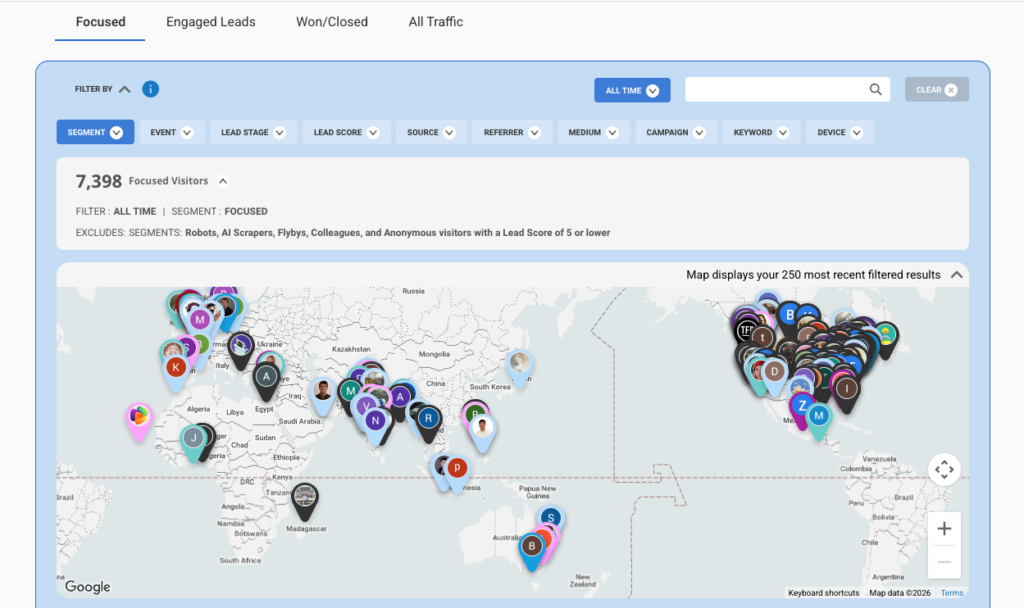
What we do instead
Bread & Butter doesn’t try to unmask anonymous traffic. We think the more useful signal is the one a visitor gives you on purpose, and the real value is in what we do with it after.
From the first click, we gather the behavioural journey server-side. That part needs no guessing and no cookie. What we hold back is identity. Identity resolves when a real person does something intentional, fills a form, or submits an email. We call that the hand-raise. At that moment we already have the full behavioural story, so we enrich the record, score the intent with our Focus Score, and show you how much of your traffic is genuinely high-intent through the Focused Index. That’s lead intelligence, not a raw feed of maybes.
A cleaner CRM, as a bonus
Because we’re watching real behaviour rather than just catching form submissions, we can tell a genuine visitor from a spam or bot fill and stop the junk before it lands in your CRM. Your team spends its time on real people instead of clearing out fake emails.
The compliance angle, briefly
There’s another reason we built it this way. Tracking named individuals without consent is where most privacy violations occur, which is why person-level identification tools carry higher compliance risk and require explicit consent, disclosed data practices, and legal review before deployment. Because our identity resolution is triggered by the visitor’s own action, we sidestep that grey area rather than working around it.
The honest version
IP tools aren’t useless. If your goal is broad account-level awareness for ABM, company-level identification is a mature, mostly compliant approach, and it has its place. But if your goal is pipeline, a feed of maybes needs a lot of qualifying before it becomes a conversation. Lead intelligence does that qualifying for you, so your team can spend its time on the thing it’s actually good at. Closing.
We remove the noise so you can see the signal.
Real signal, real scores, real pipeline. That’s Bread & Butter.